
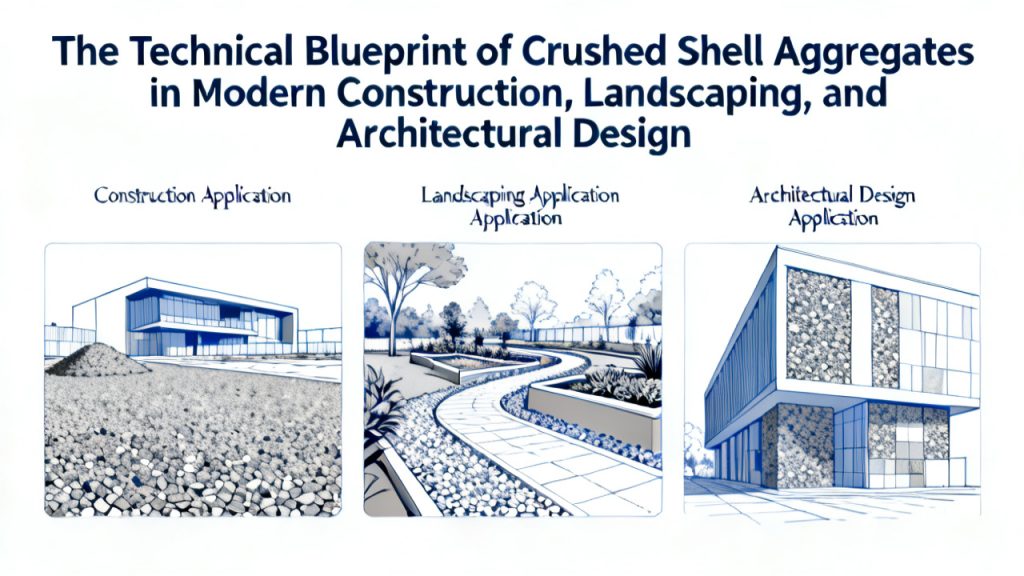
In the transition toward circular economies and sustainable building practices, procurement officers, civil engineers, and landscape architects are increasingly looking beyond traditional quarried minerals. Among the most versatile, ecologically viable, and structurally sound alternatives emerging in the B2B sector is crushed marine shell aggregate. Derived primarily from post-industrial seafood processing byproduct, Crushed Shells offer a high-performance, carbon-neutral solution for a wide range of applications, from high-traffic driveways and commercial landscaping to premium terrazzo flooring.
1. Civil Engineering & Infrastructure: Crushed Shells as High-Performance Driveway Material
When specifying materials for low-volume roads, pedestrian pathways, and commercial parking areas, engineers must balance permeability, load-bearing capacity, and long-term maintenance costs. Traditional gravel and crushed stone often require frequent grading and contribute to high stormwater runoff rates. In contrast, crushed shell driveway material offers unique mechanical properties that improve over time.
The Science of Self-Compaction and Interlocking
Unlike angular gravel, which can shift laterally under vehicular load, crushed oyster and clam shells possess a flat, irregular geometry. Under the weight of traffic, these pieces slide and lock together in a process known as aggregate interlocking. As the shells are exposed to moisture and pressure, they undergo minor surface dissolution, releasing calcium carbonate (CaCO3). This chemical byproduct acts as a natural, mild cementing agent, binding the aggregate into a stable, semi-pervious crust. This self-healing property minimizes rutting, potholes, and dust generation.
Hydraulic Conductivity and Stormwater Management
With municipal stormwater regulations becoming increasingly stringent, maintaining high permeability is critical for commercial developments. Crushed shell driveways maintain a high void ratio, allowing rainwater to infiltrate directly into the subgrade. This reduces the load on municipal retention basins, mitigates localized flooding, and filters out suspended solids and heavy metals before they reach local aquifers.
2. Commercial Horticulture and Soil Science: Marine Mulch and Soil Amendments
For landscape architects and commercial horticulturists managing large-scale public parks, corporate campuses, or botanical installations, soil health and moisture retention are paramount. Traditional wood mulches decompose rapidly, stripping nitrogen from the soil and requiring annual replacement. Utilizing seashell mulch for flower beds and ornamental plantings offers a highly stable, chemically active alternative.
Biogeochemical Soil Buffering
Crushed oyster shells are composed of approximately 95% calcium carbonate. When utilized as a mulch or incorporated directly as crushed oyster shells for garden beds, they act as a slow-release soil conditioner. Over multi-year cycles, acidic rainwater slowly dissolves the shells, releasing calcium ions and carbonate into the soil matrix. This process:
- Raises and stabilizes soil pH, particularly in acidic, sandy, or nutrient-leached soils.
- Improves soil structure by promoting flocculation in clay soils, enhancing aeration and root penetration.
- Supplies essential calcium, a critical macronutrient for cell wall development in plants, reducing physiological disorders like blossom end rot in ornamental and agricultural crops.
Physical Protection and Pest Mitigation
As a physical barrier, a 3-to-4-inch layer of seashell mulch offers superior thermal insulation for root systems, reducing soil evaporation rates during extreme heat events. Furthermore, the sharp, abrasive edges of crushed shells act as a natural deterrent against soft-bodied pests such as slugs and snails, reducing the reliance on chemical molluscicides in public and commercial spaces.
3. Industrial and Interior Architectural Finishes: Terrazzo and Epoxy Flooring Systems
Beyond exterior civil applications, the unique aesthetic and structural properties of marine aggregates are highly valued in interior architecture. The demand for crushed shells for terrazzo and crushed shell epoxy flooring has surged as designers seek to achieve LEED (Leadership in Energy and Environmental Design) certification while delivering high-durability, visually striking surfaces.
Physical Durability and Polishing Characteristics
Marine shells possess a Mohs hardness rating that makes them highly compatible with standard concrete grinding and polishing equipment. When suspended in a cementitious or epoxy matrix, the shell fragments polish to a high-gloss finish without fracturing or dislodging from the binder. The natural nacre (mother-of-pearl) layer present in many mollusk shells provides a subtle, iridescent reflectivity that synthetic aggregates cannot replicate, adding depth and visual texture to high-traffic lobbies, airports, and commercial showrooms.
Resin Compatibility and Chemical Resistance
In seamless epoxy resin systems, chemically inert aggregates are required to prevent curing inhibition or matrix degradation. Properly washed and graded crushed shells are highly compatible with bisphenol A/F epoxies and polyurethane binders. They exhibit low thermal expansion coefficients, reducing the risk of delamination or cracking in environments subject to thermal shock, such as commercial kitchens and pharmaceutical facilities.
4. Procurement and Logistics: Sourcing Bulk Crushed Shells for Large-Scale Projects
For procurement departments and general contractors, sourcing bulk crushed shells for yard and infrastructure projects requires strict adherence to quality assurance standards. Unprocessed marine shells can contain residual organic material, salts, and pathogens that can compromise structural integrity and cause odor issues.
Quality Control and Processing Standards
When evaluating bulk suppliers, B2B buyers should verify that the material has undergone rigorous processing, including:
- Thermal Cleansing: High-temperature washing or baking to eliminate organic tissue and pathogens.
- Desalination: Rinsing cycles to reduce soluble chloride content, preventing the corrosion of adjacent concrete reinforcement or the salinization of surrounding soils.
- Fractional Screening: Precise grading into standardized size fractions (e.g., coarse 1/2″ to 3/4″ for driveways; fine 1/16″ to 1/8″ for terrazzo and epoxy applications).
Logistical Efficiency
Because crushed shells are lighter than traditional granite or limestone gravel—often weighing up to 30% less per cubic yard—freight efficiency is significantly increased. This density differential allows for greater volume-per-shipment capacities, reducing transportation emissions and lowering the overall landed cost per square foot on large-scale commercial jobsites.
Conclusion: The Sustainable ROI of Marine Aggregates
Incorporating crushed marine shells into commercial projects is more than an aesthetic choice; it is a strategic engineering decision. By replacing quarried stone and synthetic mulches with high-purity calcium carbonate aggregates, developers can improve structural longevity, enhance soil chemistry, reduce stormwater runoff, and create stunning, light-reflective interior spaces. As the construction industry continues to prioritize circular materials, crushed shells stand out as a proven, high-performance resource that bridges the gap between ecological responsibility and uncompromising durability.